AI SEO is the work of making your business easier to parse, connect, trust, and recommend across modern search environments. That still includes traditional search engines, but it also extends to AI summaries, answer engines, assistant-driven discovery, and the broader systems buyers use to evaluate vendors before they ever submit a form.
For many businesses, the real problem is not a lack of information. It is fragmented information. Services are unclear. Pages overlap. Offers are buried. Authority signals are thin. Content exists, but it does not reinforce a strong structure. AI SEO solves for that by improving the way your business is represented across content, architecture, technical signals, and conversion pathways.
If you want the broader parent hub, start with How to Improve Brand Visibility in AI Search .
For the narrower supporting topics in this cluster, see What Is AEO and What Is GEO .
What AI SEO Means Now
AI SEO is not just “SEO with AI tools.” It is optimization for an environment where discovery increasingly happens through layered systems that summarize, interpret, and recommend.
That shift changes the job. A page no longer succeeds only because it ranks for a keyword. It also has to be legible enough for search engines, AI systems, and human buyers to understand what the business does, who it serves, why it is credible, and what the next step should be.
In practice, AI SEO usually involves:
- clearer service and offer positioning
- stronger page hierarchy and internal linking
- content designed around real buyer questions
- technical signals that reinforce meaning and trust
- authority signals that support recommendations
- conversion pathways that make the traffic useful
This is why AI SEO overlaps with AI SEO Services , AI-Structured Website , and Content Strategy for AI, Search, and Humans . It is not one tactic. It is a connected discipline.
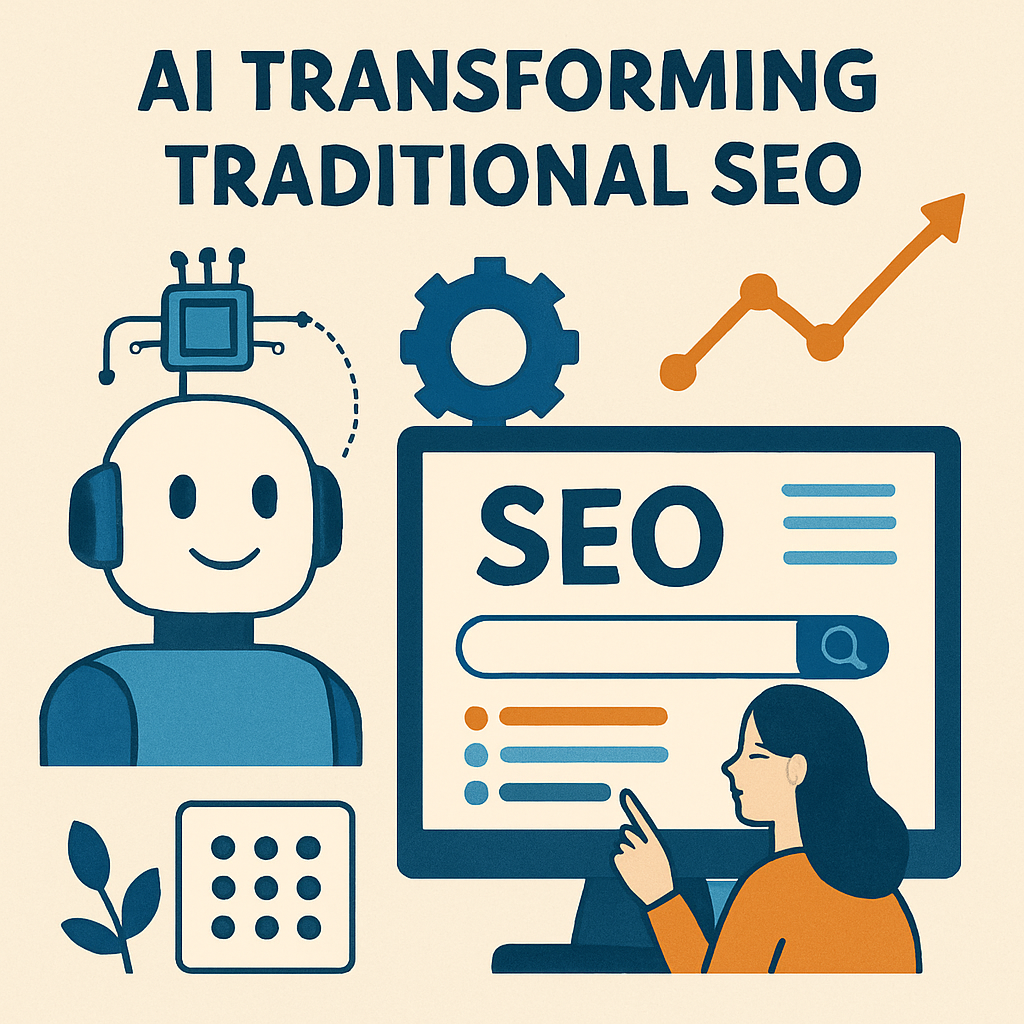
How AI SEO Differs From Traditional SEO
Traditional SEO still matters. You still need indexable pages, strong titles, useful content, solid internal linking, and healthy technical foundations. None of that disappeared.
What changed is the discovery layer around it.
Traditional SEO often focused heavily on keywords, rankings, and page-level optimization. AI SEO expands the frame. It asks whether the business is understandable across the full system that now influences discovery:
- search results pages
- AI-generated summaries
- answer engines
- conversational search experiences
- branded and non-branded recommendation contexts
That means AI SEO is usually less about isolated tricks and more about coherence. If your site says one thing, your service pages imply another, your trust signals are weak, and your conversion path is unclear, the problem is not simply “ranking.” The problem is that the business is not being represented cleanly enough.
The better way to think about it is this: traditional SEO often optimized pages, while AI SEO optimizes understanding.

What Strong AI SEO Includes
Strong AI SEO usually sits across five connected layers.

1. Service and Offer Clarity
If your site does not clearly explain what you do, who it is for, and what makes the offer distinct, optimization work gets harder everywhere else. Search systems and buyers both need clean inputs.
This usually means tightening:
- service naming
- audience language
- page intent
- supporting proof
- calls to action

2. Content That Answers Real Questions
Good AI SEO content is not just long. It is useful, structured, and aligned with buyer intent.
That includes content for:
- category understanding
- service education
- evaluation questions
- objections and comparison points
- industry or use-case relevance
The goal is to create pages that are genuinely answerable, quotable, and linkable instead of generic blog filler.

3. Strong Information Architecture
AI systems and users both benefit when your site has a clear hierarchy. Related pages should reinforce each other. Core pages should not compete with each other. Supporting content should deepen understanding, not scatter it.
This is one reason an AI-structured website matters. The structure around the copy affects how easily the business can be interpreted.

4. Technical and Semantic Reinforcement
Technical SEO still matters, but the point is not to chase a checklist for its own sake. The point is to remove friction from interpretation.
That includes work like:
- crawlability and indexation review
- metadata quality
- heading and page structure
- schema and semantic signals where useful
- internal linking logic
- page performance and usability

5. Authority and Trust Signals
If a site makes claims without evidence, visibility gains are harder to defend. AI SEO should strengthen the supporting context around the business.
That may include:
- stronger about and expertise signals
- better case study pathways
- clearer methodology
- industry specificity
- proof embedded near high-intent pages
You can see parts of that framing across Case Studies and About .

Why Structure Matters as Much as Content
Many companies think they need “more AI content” when the bigger issue is weak structure.
If you publish extensively on a confusing site, you usually just scale confusion. Pages overlap. Similar topics cannibalize each other. Visitors do not know where to go next. Important services remain underexplained. Internal links fail to reinforce a clean model of the business.
Pillar pages solve part of that problem. They create a clear parent page that defines the topic, frames its importance, and routes readers to supporting pages that go deeper. For a Hugo site like this one, that is especially useful because it gives the content architecture a stronger center of gravity.
For this topic cluster, the parent hub is How to Improve Brand Visibility in AI Search . This AI SEO page works as one of the supporting child pages alongside narrower supporting topics such as:
- AI SEO Services
- AI-Structured Website
- Content Strategy for AI, Search, and Humans
- What Is AEO
- What Is GEO
That structure helps users, supports internal linking, and gives search systems a clearer picture of topical relationships.
How AI SEO Supports Lead Generation
Visibility by itself is not enough. If better discoverability does not create better opportunities, the system is incomplete.
That is why effective AI SEO should connect directly to lead generation. The same work that improves interpretation often improves conversion quality:
- clearer offers reduce friction
- better content pre-qualifies buyers
- stronger authority signals reduce skepticism
- cleaner user flow increases action rates
- better internal linking moves visitors toward decision pages
This is also why AI SEO should not be separated from lead generation or the broader Growth System . When those pieces are disconnected, teams often generate traffic that does not convert well or optimize pages that attract the wrong audience.
The more mature approach is to connect discoverability, trust, and conversion into one operating model.

How to Measure AI SEO
AI SEO should be measured with business-aware metrics, not just vanity metrics.
Useful indicators often include:
- growth in qualified organic traffic
- visibility for service-aligned topics
- better engagement on core pages
- stronger internal page journeys
- more inquiries from relevant audiences
- improved conversion rates on key entry pages
- stronger performance across branded and non-branded discovery
The exact measurement model depends on the business. A local service business, a B2B firm, and a niche category creator will not all track success the same way.
What matters is whether the site is becoming easier to understand and easier to act on. Rankings can be part of that picture, but they are not the full picture.
If you are evaluating where the biggest gaps are today, the AI Visibility Assessment is the cleanest entry point.

Common Mistakes
A lot of AI SEO work underperforms because it focuses on output volume rather than signal quality.
Common mistakes include:
- publishing large amounts of generic AI-assisted content without a clear content model
- creating pages before clarifying service architecture
- treating tools as strategy
- chasing prompts instead of fixing site structure
- ignoring trust signals and proof
- measuring activity instead of business outcomes
Another frequent problem is building multiple pages that target nearly the same idea with no clear distinction in purpose. Pillar pages, supporting pages, and service pages need different jobs. If they all say roughly the same thing, they weaken each other.

How Lagraphia Approaches AI SEO
Lagraphia approaches AI SEO as part of a connected visibility system, not as isolated publishing or ranking work.
That usually means working across:
- business and offer clarity
- site structure and page relationships
- answer-first content planning
- trust and authority reinforcement
- conversion-aware user flow

The point is to help a business become easier to understand across both human and machine-mediated discovery. That is why adjacent pages like All Services , AI SEO Services , and AI-Structured Website matter. They are not separate ideas so much as connected parts of the same system.
If you want to talk through the fit, the best next step is a discovery call .